
What is GRP?
1. The material in brief
GRP (glass-reinforced plastic, also GFRP or simply fibreglass) consists of glass fibre reinforcement in a polyester, vinyl ester or phenolic resin matrix. The fibres provide strength and stiffness; the resin provides shape, chemical resistance and load transfer between the fibres.
Fibre content, fibre orientation and resin can be selected to suit the application. This also means data must always be read against a specific product — GRP is not a single material with a single value.
2. Manufacturing methods
Pultrusion is a continuous process in which fibres are drawn through a resin bath and a heated die. It produces profiles and grating with consistent properties, a high fibre fraction in the longitudinal direction and tight tolerances.
Moulded grating is produced in a mould with fibres in two directions. The result is bi-directional load distribution, high impact resistance and very good chemical resistance.
3. Properties
- Corrosion resistance to water, chlorides, many acids, alkalis and solvents — without surface treatment.
- Low weight, roughly a quarter of the density of steel, simplifying installation and reducing load on existing structures.
- High strength-to-weight ratio in the fibre direction.
- Electrically and thermally insulating, with no galvanic corrosion against other materials.
- Non-magnetic and radio-transparent.
- Slip-resistant surfaces can be integrated into the product rather than applied afterwards.
- Low maintenance — no painting, galvanising or cathodic protection.
4. Typical material values
Values are typical for pultruded GRP and vary with product, resin and fibre orientation. Always use product-specific documentation for structural sizing.
5. Limitations to consider
GRP is anisotropic: stiffness and strength are considerably higher along the fibres than across them. The design must follow the fibre direction.
The E-modulus is lower than that of steel, so deflection rather than failure is often the governing criterion.
Service temperature is limited and properties decrease at elevated temperature; specialist resins are required for higher temperatures.
Cut edges and drilled holes must be sealed to maintain full corrosion protection.
Fire requirements must be verified against the correct resin system and test standard — fire classification is not a general property of GRP.
6. Comparison with other materials
| Material | Corrosion | Weight | Maintenance | Conductive |
|---|---|---|---|---|
| GRP | Resistant | Low | Low | No |
| Galvanised steel | Coating required | High | Recurring | Yes |
| Aluminium | Galvanic risk | Medium | Low | Yes |
| Timber | Rot and moisture | Low | High | No |
7. Common applications
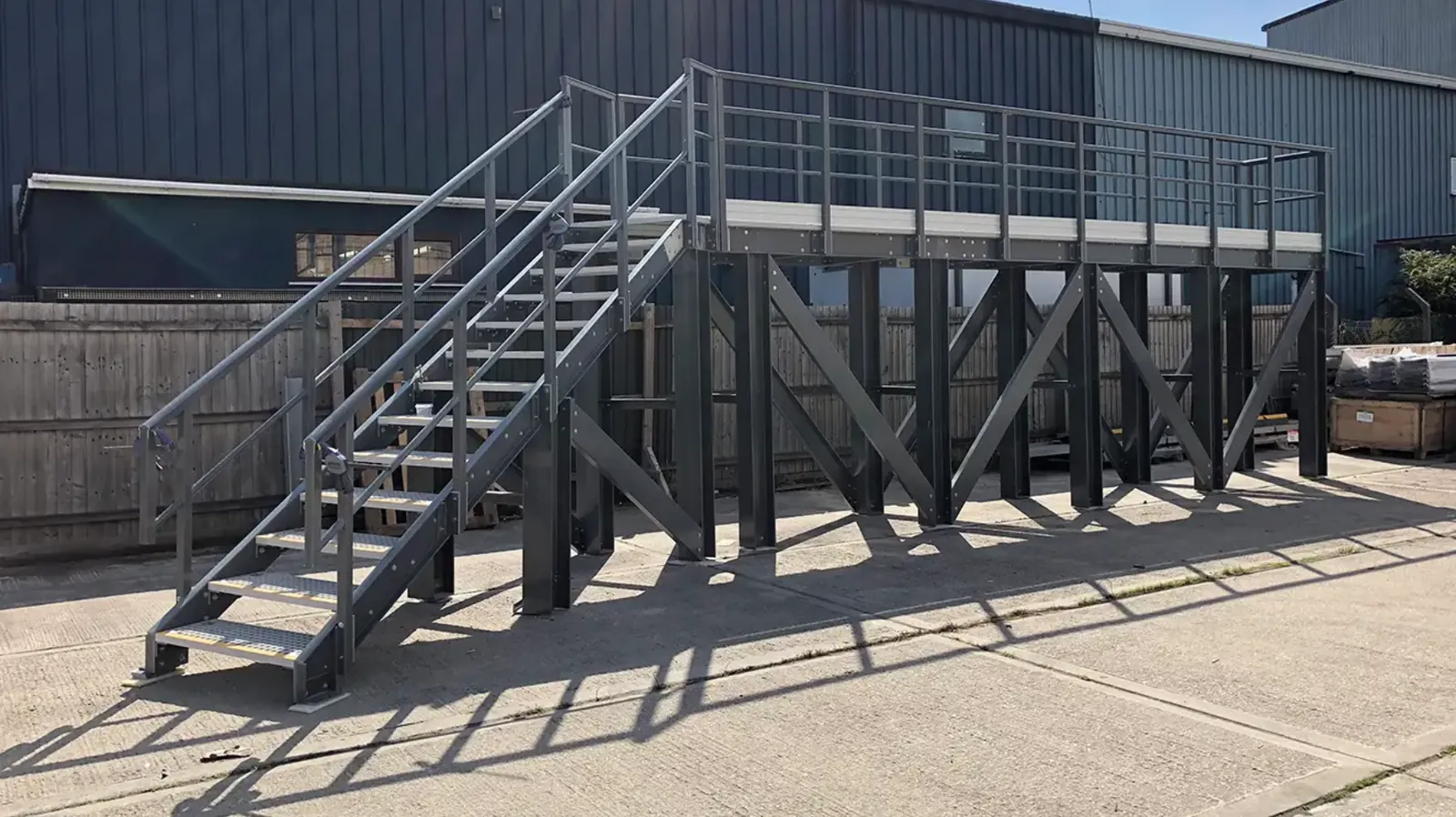
Industrial walkways, platforms, stairs and stair treads, handrail systems, cable troughs and cable ladders, grating in water and wastewater plants, jetties and marine structures, service platforms in energy and wind power, and walking surfaces in rail and tunnel environments.
8. Fabrication and installation
- Cut with a diamond or fine-tooth carbide blade.
- Drill with HSS or carbide bits at a low feed rate.
- Respiratory protection, eye protection and gloves during all fabrication.
- Seal cut edges and openings with a compatible resin.
- Use stainless fixings (A4) in marine and chemical environments.
9. Sustainability and service life
Long technical service life, low maintenance and low transport weight are the main factors affecting the life-cycle environmental performance of GRP. Products are supplied with third-party verified environmental product declarations (EPD) to EN 15804, allowing climate impact to be included in climate declarations and environmental certification.
Environmental performance should always be compared using EPD data for the specific alternative and the functional unit that applies in the project.
Need technical advice?
Expert support for GRP solutions.
Detailed planning and CAD.
We come to your facility.
Certified installers on site.
Fast and accurate cost estimates.