
GRP for Industrial & Commercial
Across process and manufacturing industries, the demands placed on materials keep rising — corrosion, chemicals, moisture and heavy loading must all be handled while keeping the working environment safe and maintenance costs down. GRP (Glass Reinforced Plastic), also known as fibreglass or composite, is a modern material solution that replaces steel and aluminium in thousands of industrial applications worldwide. Byggkomposit supplies complete GRP systems to industry — from individual grating panels and pultruded profiles to fully engineered platforms, walkways, handrailing and stair towers.
GRP consists of glass fibre reinforcement embedded in a thermoset resin matrix (typically polyester, vinyl ester or phenolic). The result is a material with specific strength comparable to structural steel — but at a fraction of the weight, and completely corrosion-free. For industrial plants this means dramatically lower maintenance costs, fewer shutdowns and longer service life. In many process environments GRP is the only material that meets the chemical and electrical requirements without expensive coatings or ongoing upkeep.
Reference images
Why industry chooses GRP products
Six decisive properties that make fibreglass the obvious choice for modern industrial facilities — from food production to heavy chemical processing.
Corrosion-resistant
GRP does not rust and resists acids, alkalis, solvents and saltwater — ideal for aggressive industrial environments.
Electrically non-conductive
Glass reinforced plastic does not conduct electricity, increasing safety on sites with electrical hazards.
Easy to install
Products weigh approximately 30% of equivalent steel and are cut on site with standard tools — no hot works.
Fire-rated options
Our GRP products are available in fire-rated grades to EN 13501, meeting strict process industry requirements.
Anti-slip surface
Embedded quartz grit provides permanent slip resistance — even with oil, water and chemical spills.
Long service life
Low maintenance for 25+ years with no painting, blasting or rust protection. Lower LCC than steel.
Applications for GRP in industry
GRP is now used across virtually every industrial sector — from food, pulp and paper to chemical, energy and heavy engineering. The most common applications involve walking surfaces, working platforms, handrailing, stairs and load-bearing structures where traditional steel either corrodes too quickly or is simply too heavy to handle. Below are some typical use cases where our GRP products deliver clear advantages over steel.
Platforms, walkways and working surfaces
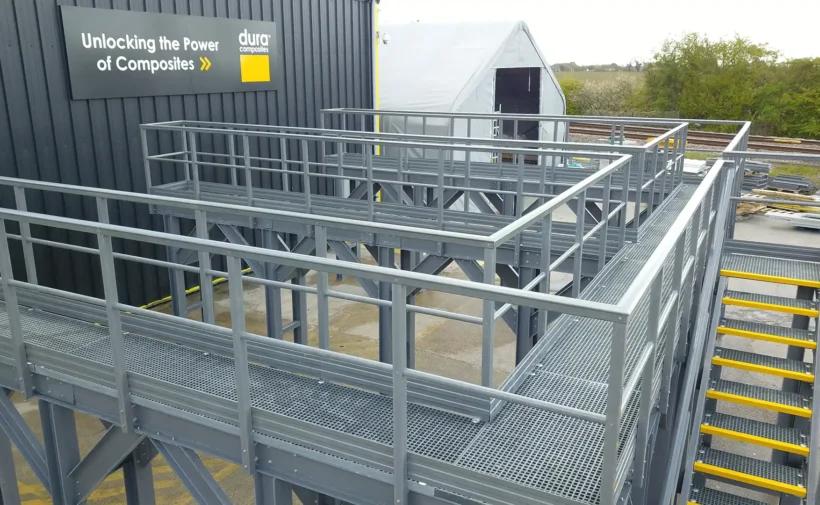
GRP grating is the industry standard for process platforms, walkways and service routes. The high open area lets liquids, spills and debris fall through instead of accumulating on the surface — improving safety and reducing cleaning. Combined with pultruded GRP profiles we build complete platform systems up to 70% lighter than steel, with equivalent or higher load-bearing capacity. This simplifies both installation and any future modifications.
Handrailing, balustrades and fall protection
Modular GRP handrailing meets fall protection requirements while eliminating the issues of rust, galvanising and recurring painting. Because GRP is electrically non-conductive it is also specified as handrail in substations, transformer yards and other electrically exposed environments. The grip-friendly surface neither becomes scorching hot in sun nor freezing cold in winter — a major benefit for staff working outdoors year-round.
Process, chemical and water plants
In chemical processes, treatment works, pickling baths and paper mills, materials are exposed to aggressive chemicals and constant moisture. Here GRP outperforms both steel and stainless — vinyl ester-based composites withstand most acids, alkalis and solvents without degradation. We supply GRP structures to Swedish treatment works, paper mills and process plants where previous steel constructions had to be replaced every 5–10 years. With GRP, 25–40 years of service life is normal — with no coating.
Stairs, ladders and access routes
GRP stair treads with integrated anti-slip nosings are widely used on tank tops, around boilers, along conveyors and in every type of access route. The low weight means individual components can be carried by one or two people, saving time and crane lifts during installation. The combination of slip resistance, corrosion immunity and electrical insulation makes GRP stairs a natural choice for modern industrial sites.
Total cost of ownership — GRP vs steel in industry
When industrial buyers compare materials, steel often appears cheaper at first glance. Across the full life cycle the picture quickly reverses. Steel requires painting, repainting, blasting and in many cases full replacement after 10–15 years in corrosive environments. GRP is low-maintenance throughout its service life and needs neither rust protection nor surface treatment. Add lower transport cost, faster installation, fewer working hours at height and reduced injury risk — and GRP products are in most cases the most economical option over the lifetime of the asset.
We help industrial customers calculate Life Cycle Cost (LCC) and demonstrate the savings against traditional solutions. In many projects the additional investment in GRP is recovered within 3–5 years — and every year thereafter generates pure savings for as long as the plant is in operation. Want to know how GRP could fit your site? Get in touch for a no-obligation review.
Want to explore Dura Composites' global reference projects in industrial & commercial? Read more about GRP in industrial and commercial at Dura Composites (opens in a new tab).
Need technical advice?
Expert support for GRP solutions.
Detailed planning and CAD.
We come to your facility.
Certified installers on site.
Fast and accurate cost estimates.